A Conversation with Dr. Manu Sidhu Part 2: Driving Towards Better Patient Outcomes
Signal Talks continues with Dr. Manu Sidhu on the use of AI in mental health care, the misconceptions around it, and paths to better patient outcomes.
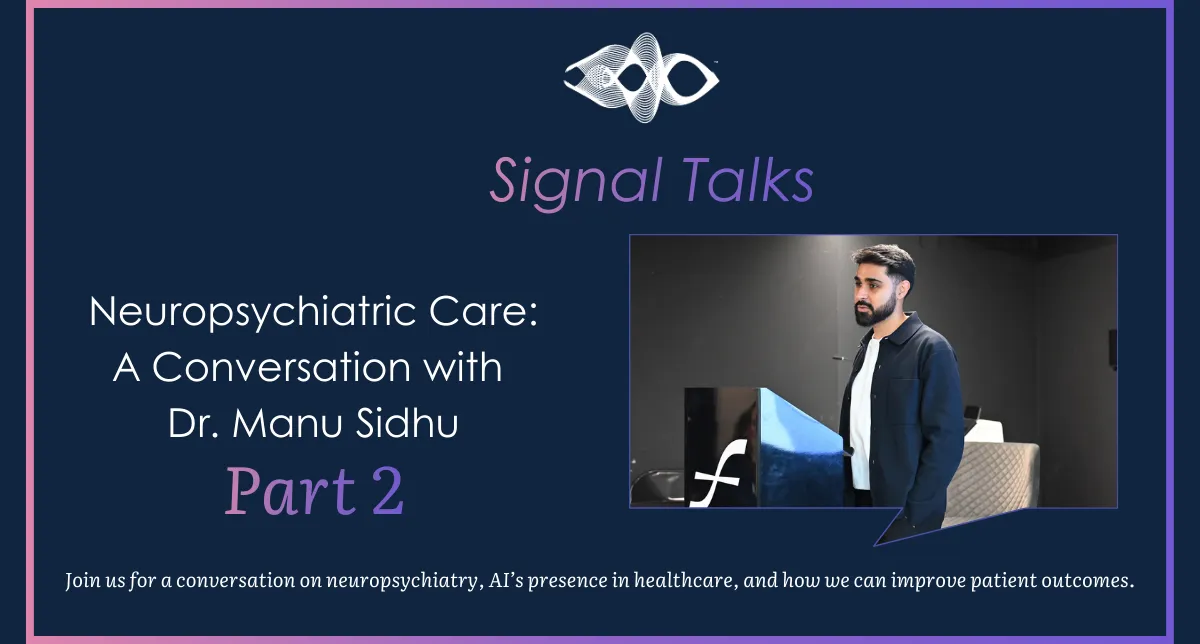
Welcome back to our new series, Signal Talks, presented by Mindsigns Health™. Here, we speak with stakeholders in the medical-tech industry on what they’re seeing, and what they hope to achieve in the future.
We’re continuing our conversation with Dr. Manu Sidhu as part of Mental Health Month, where we delve deeper into the use of AI and potential paths to improvements in patient outcomes.
Misconceptions can often occur regarding your field. What is a common one in mental health treatment?
A common misconception is that mental health problems are caused by either biological, psychological, or social factors. In reality, biology shapes how reactive and resilient the brain and body are, psychology shapes how we interpret and respond to what happens, and social context shapes what happens to us and what support we have - so each continuously influences the others in a feedback loop.
It’s similar to opportunistic infections: a pathogen may be present, but it usually only causes a serious problem when another part of the system is weakened - so you have to look at the whole host, not just the bug.
The clinical skill is in understanding how the biopsychosocial factors interrelate for each individual and designing an integrated plan that targets the key levers across the system.
AI is on the rise in the healthcare space. Where do you foresee it improving the industry without eliminating the human element?
AI should be used to upgrade the scaffolding around care, not to replace care. Here are a few use cases that promote humane care:
- Signal-to-insight translation: turning complex physiological and behavioural signals into interpretable markers clinicians can use
- Early warning and relapse prevention: pattern detection that flags deterioration sooner with clinician oversight
- Decision support: surfacing options, risks, and guideline-aligned prompts - while the clinician retains accountability
- Reducing admin load: documentation, triage routing, and coordination - freeing clinicians to do what humans can do better: build trust, hold uncertainty, and treat the person in context
Mindsigns Health™ uses AI-powered tools to help turn signals and biomarkers into objective insights. How do you see the company helping in this space of neuropsychiatric care?
Mindsigns Health™ can help solve core psychiatric problems: too much uncertainty, too late, with too little objective signal. Conceptually, that means:
- Capturing meaningful signals (physiological and behavioural)
- Transforming them into validated measures anchored to real clinical outcomes
- Delivering clinician-usable insights (clear trends, thresholds, alerts, response trajectories)
In neuropsychiatric care specifically, the win is objective, longitudinal tracking - helping clinicians and patients see whether sleep, arousal, cognition, or behavioural disruption is stabilising or drifting, and intervene earlier.
What are some goals you have in mind to help improve patient outcomes?
- Clinical validity first: demonstrate that Mindsigns-derived insights reliably correlate with clinically meaningful endpoints (symptoms, functioning, relapse risk, response).
- Safety by design: clear escalation pathways, bias monitoring, and clinician-in-the-loop accountability.
- Workflow integration: ensure outputs are simple, interpretable, and fit within real clinical time constraints
- Equitable deployment: test across diverse populations and settings so benefits don’t concentrate in the already-advantaged
- Outcome-driven implementation: measure what matters to every stakeholder (especially the patient) - reduced relapse, improved function, better engagement, fewer crisis presentations, and higher patient confidence in self-management
Thank you to Dr. Sidhu for the insights during Mental Health Month! We hope you enjoyed this edition of Signal Talks, presented by Mindsigns Health™.


